

Choosing the best POS for retail business in the Philippines is an important decision. The right system can help you manage sales, inventory, employees, branches, and BIR requirements more efficiently.
Many retailers wait until they experience a system failure, stock-counting problems, or long checkout queues before upgrading their POS. By then, changing systems can be more difficult and expensive.
Today, Philippine retailers can choose from many POS providers. Some are cloud-based, while others use on-premise systems. There are also POS platforms designed specifically for payments, accounting, inventory, or enterprise operations.
So, which system is right for your business?
This guide compares seven POS systems commonly considered by Philippine retailers: Condor POS, StoreHub, QNE, Maya POS, Loyverse, UTAK, and HashMicro.
We will look at the features that matter most, including BIR compliance, inventory management, offline functionality, multi-branch support, hardware, pricing, and technical support.
Whether you operate a small retail store, pharmacy, specialty shop, or multi-branch business, this guide can help you identify the right POS solution for your needs.
What to Look for in a Retail POS System
Before choosing a POS provider, it is important to understand which features your business actually needs.
The best POS for retail business in the Philippines should do more than process transactions. It should help you manage your daily operations and support your business as it grows.
Here are the key features to consider.
1. BIR Compliance and Official Receipts
BIR compliance is one of the most important considerations for Philippine businesses.
A retail POS should support compliant sales documentation and reporting requirements. Depending on the business and setup, retailers may also need a system and Permit to Use (PTU) registered with the Bureau of Internal Revenue.
Look for features such as:
- X-reading and Z-reading reports
- VAT and non-VAT transaction handling
- Sales and eSales reporting
- BIR-compliant receipt or invoice generation
- Support for current BIR requirements
- Assistance with registration and compliance processes
Be careful when evaluating claims about being “BIR-accredited.” Ask the provider what compliance support is included and whether they can assist with your store-level registration requirements.
2. Real-Time Inventory Management
Inventory accuracy is essential for retail businesses.
A good POS should automatically deduct inventory when a sale is completed. It should also help you identify products that are running low.
Important inventory features include:
- Automatic stock deduction
- Barcode scanning
- Low-stock alerts
- SKU-level inventory tracking
- Product variants
- Composite or bundled products
- Stock transfers
- Multi-branch inventory management
If you operate multiple stores, make sure inventory can be monitored across branches.
3. Offline POS Functionality
Internet connectivity can be unreliable in some areas of the Philippines.
A POS that stops processing transactions whenever the internet goes down can disrupt your operations and create long queues.
For this reason, retailers should consider whether the POS offers genuine offline transaction processing.
An offline-capable POS should allow staff to continue processing sales and synchronize information once the connection is restored.
4. Multi-Branch and Multi-Store Management
Growing retailers need more than a system that works at one checkout counter.
If you operate multiple branches, your POS should provide centralized visibility across locations.
Useful features include:
- Consolidated sales reports
- Branch-level inventory
- Stock transfers
- Centralized product management
- Price and promotional updates
- Staff management
- Multi-branch reporting
Even if you currently operate only one store, it is worth considering your future expansion plans before choosing a POS.
5. Reliable POS Hardware and Technical Support
POS software is only one part of your retail system.
Your business also depends on hardware such as:
- POS terminals
- Receipt printers
- Barcode scanners
- Cash drawers
- Customer displays
Hardware problems can immediately affect sales. Therefore, check the provider’s warranty, replacement process, and technical support options.
Local technical support can also be valuable when you need troubleshooting or on-site assistance.
6. Pricing: Subscription vs. One-Time License
POS pricing in the Philippines generally follows several models.
These include:
- Free POS applications
- Monthly cloud subscriptions
- Per-terminal subscriptions
- One-time or on-premise licenses
- Enterprise or custom pricing
Cloud subscriptions can have a lower initial cost. However, monthly fees can increase as you add stores, terminals, or users.
On-premise systems can require a larger upfront investment but may offer greater local control and lower recurring costs depending on the setup.
The best option depends on your budget, business size, number of branches, and long-term plans.
Top Retail POS Systems in the Philippines for 2026
Below is a comparison of seven POS providers commonly considered by Philippine businesses.
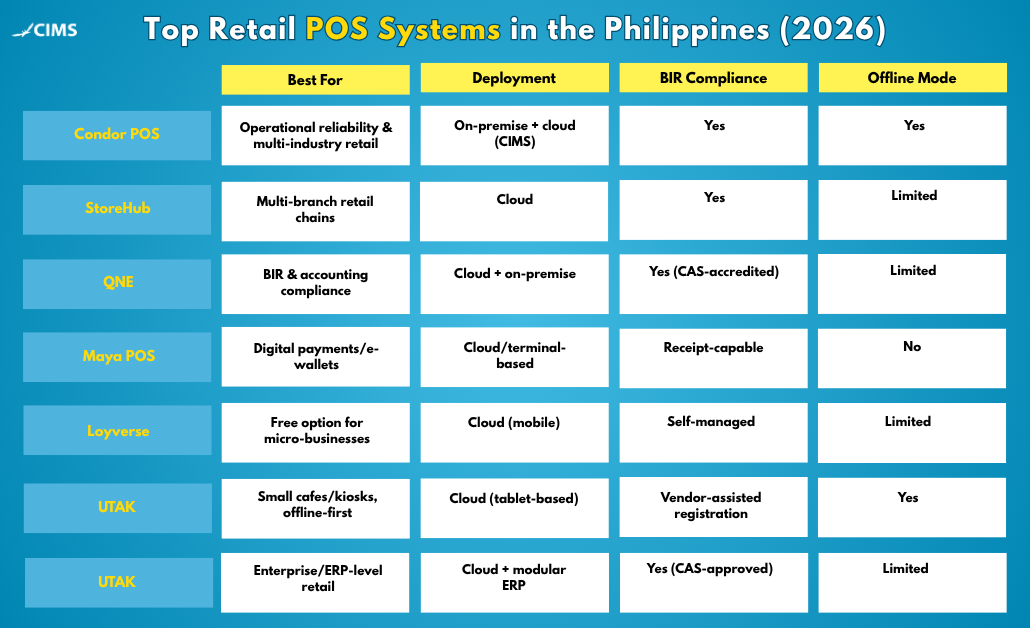
1. Condor POS — Best for Retail Operations and Reliability
Condor POS Solutions has been serving Philippine businesses since 2009. Its Condor Inventory Management System (CIMS) is an on-premise POS platform with optional cloud connectivity.
The system is designed to continue supporting business operations during internet downtime. This can be particularly useful for retailers, pharmacies, and service businesses that cannot afford to stop processing transactions.
Key capabilities include:
- BIR-compliant receipting
- Multi-branch inventory management
- Staff and user access controls
- Offline transaction processing
- POS hardware solutions
- Local technical support
Condor also supplies and services its own POS hardware, giving businesses a more integrated software and hardware setup.
Best for: Retailers looking for operational reliability, offline functionality, BIR compliance, and multi-branch capabilities.
2. StoreHub — Best for Multi-Branch Retail Chains
StoreHub is a cloud-based POS platform designed around centralized business management.
It provides features such as:
- Multi-location management
- Real-time inventory
- Staff management
- Loyalty tools
- Sales reporting
- Third-party integrations
Its centralized dashboard can be useful for retailers managing several branches.
The main consideration is its cloud-based model, which means businesses should evaluate how the system performs when internet connectivity is limited.
Best for: Multi-branch retailers that prioritize centralized cloud management.
3. QNE — Best for BIR and Accounting Compliance
QNE combines POS and inventory capabilities with accounting software.
Its platform is particularly relevant to businesses that want their sales information connected to accounting and tax-related processes.
Features include:
- Accounting
- POS
- Inventory management
- BIR-related reporting
- Tax forms
- DAT file generation
This makes QNE a strong option for retailers whose accounting and compliance requirements are a major priority.
Best for: Retail businesses that need POS and accounting functions within one ecosystem.
4. Maya POS — Best for Digital Payments
Maya’s POS and terminal solutions focus heavily on digital payment acceptance.
The solutions support payment methods such as:
- Credit cards
- Debit cards
- QR Ph
- E-wallets
For businesses that primarily need a convenient way to accept different digital payment methods, Maya can be a useful solution.
However, retailers looking for deeper inventory management, multi-branch operations, and comprehensive retail management may need a dedicated POS platform alongside payment services.
Best for: Businesses that prioritize digital payments and e-wallet acceptance.
5. Loyverse — Best Free POS for Micro-Businesses
Loyverse is a popular option for micro-businesses because its core POS features are available without a subscription fee.
The platform supports basic functions such as:
- Sales tracking
- Basic inventory
- Customer management
- Mobile POS operations
Additional features are available through paid add-ons.
Loyverse can be attractive to startups and very small retailers that want to begin digitizing their sales operations without a large initial investment.
However, businesses should carefully review their BIR compliance requirements and multi-location needs before choosing a free POS.
Best for: Micro-businesses and startups looking for a low-cost POS solution.
6. UTAK — Best for Small Businesses and Offline-First Operations
UTAK is a tablet-based POS platform designed for smaller businesses.
Its features include:
- Inventory management
- Sales dashboards
- Automatic inventory deduction
- Online ordering
- Offline functionality
It can be suitable for small businesses that want a relatively simple POS solution without a complex implementation.
Best for: Small retail businesses, kiosks, and businesses that value offline functionality.
7. HashMicro — Best for Enterprise and ERP-Level Operations
HashMicro positions its POS as part of a broader ERP ecosystem.
Its platform can connect POS operations with areas such as:
- Inventory
- Procurement
- Accounting
- Human resources
- Financial reporting
- Multi-branch management
This makes it more suitable for larger organizations that need multiple business functions connected within one system.
Best for: Large retailers and enterprises that need POS integrated with ERP operations.
Condor POS vs. Other Retail POS Systems
When comparing the best POS for retail business in the Philippines, it is important to look beyond the monthly price.
The right POS should match your operational requirements.
Pricing Model
Condor POS uses an on-premise licensing model with optional cloud connectivity. This can be attractive to businesses that prefer to avoid recurring subscription costs.
StoreHub and other cloud-based platforms generally use subscription-based pricing.
Other providers may offer free plans, terminal-based pricing, or customized enterprise packages.
Offline Mode
Offline capability can be important for Philippine retailers.
Condor POS supports offline transaction processing, allowing stores to continue operations during internet interruptions.
Businesses should carefully check the offline capabilities of cloud-based alternatives because some may only support limited functions when the connection is unavailable.
BIR Compliance
BIR compliance should be a key consideration when choosing a retail POS.
Condor POS provides BIR-compliant receipt generation and reporting capabilities.
QNE focuses heavily on accounting and tax compliance, while other platforms may require businesses to manage some compliance requirements separately.
Always confirm the current compliance status and registration requirements directly with the POS provider before purchasing.
Inventory Management
Inventory is one of the most important functions of a retail POS.
Condor POS and StoreHub provide multi-branch inventory capabilities.
QNE connects inventory with accounting functions, while Loyverse provides basic inventory features with additional functionality available through paid options.
Maya POS is primarily focused on payment acceptance rather than comprehensive retail inventory management.
Hardware
Condor POS provides POS hardware designed for business use.
Other platforms may work with third-party hardware, partner hardware, mobile devices, or proprietary payment terminals.
When comparing hardware, consider:
- Durability
- Warranty
- Replacement availability
- Compatibility
- Technical support
- Long-term maintenance
Industries Served
Different POS providers focus on different types of businesses.
Condor POS supports industries including:
- Retail
- Food and beverage
- Pharmacy
- Service centers
StoreHub serves retail, F&B, and franchise businesses.
QNE has a broader SME focus, while Loyverse is particularly popular among small retail and F&B businesses.
Technical Support
Technical support becomes increasingly important as your business grows.
Condor POS provides local technical support and on-site assistance.
Before purchasing any POS, ask how support works, how quickly issues are handled, and whether on-site assistance is available when hardware problems occur.
Why Choose Condor POS for Retail?
For retailers looking for a POS system that prioritizes reliability and operational continuity, Condor POS offers several advantages.
On-Premise + Cloud Flexibility
Condor’s CIMS platform combines an on-premise POS environment with cloud connectivity.
This setup allows core store operations to continue locally while providing cloud-based capabilities for reporting and visibility.
For businesses operating in areas with inconsistent connectivity, this can be an important advantage.
Reliable POS Hardware and Local Support
POS hardware needs to withstand daily use.
Condor provides and supports its own POS hardware, helping businesses maintain a more integrated hardware and software environment.
Local technical support can also help retailers resolve hardware and software issues more quickly.
BIR-Compliant Receipting and Reporting
Condor POS supports BIR-compliant receipt generation, VAT and non-VAT handling, and sales reporting.
This can help retailers simplify daily reporting and reduce manual processes.
Businesses should still confirm their specific BIR registration and compliance requirements with the provider and the BIR.
Proven Experience Since 2009
Condor POS Solutions has operated in the Philippine market since 2009.
The company supports businesses across industries such as retail, restaurants, pharmacies, and service businesses.
Its experience in the local market allows the platform to address operational requirements specific to Philippine businesses.
How to Choose the Best POS for Your Retail Business
There is no single POS system that is perfect for every retailer.
The best POS for retail business in the Philippines depends on your store size, budget, connectivity, compliance requirements, and growth plans.
For a Single Small Store
If you are starting with one store, a free or affordable POS such as Loyverse or UTAK may be enough for basic operations.
However, make sure the system can support your BIR requirements and future business needs.
For Multi-Branch Retail Businesses
If you already operate multiple branches or plan to expand, prioritize centralized management.
Condor POS, StoreHub, and HashMicro can be considered for businesses that require multi-location visibility.
For Businesses That Prioritize BIR Compliance
If compliance is a major concern, consider systems with built-in compliance and reporting capabilities.
Condor POS and QNE are options worth evaluating.
For Businesses With Unstable Internet
Offline functionality should be a major consideration.
Condor POS and UTAK offer offline capabilities that can help businesses continue processing sales when connectivity is interrupted.
For Businesses Focused on Digital Payments
If most customers pay through cards, QR payments, or e-wallets, a payment-focused solution such as Maya can be useful.
However, businesses with complex inventory and retail management requirements may still need a full POS system.
For Enterprise Retail Operations
Large organizations with complex workflows may benefit from an ERP-integrated platform such as HashMicro.
These systems can connect POS operations with accounting, procurement, inventory, HR, and other business functions.
Choosing the best POS for retail business in the Philippines comes down to your actual operational needs.
Before making a decision, consider:
- BIR compliance
- Inventory management
- Offline functionality
- Multi-branch support
- Hardware reliability
- Technical support
- Pricing
- Scalability
A low-cost POS may be enough for a small store. However, growing retailers may need a more comprehensive system that can handle inventory, multiple branches, compliance, hardware, and daily operations.
For retailers looking for a solution that combines offline reliability, BIR compliance, inventory management, POS hardware, and local technical support, Condor POS is an option worth considering.
Since 2009, Condor POS Solutions has provided POS solutions for Philippine businesses across retail, F&B, pharmacy, and service industries.
Ready to explore a POS solution for your business?
