

Opening a store inside a Philippine shopping mall involves more than finding the right location, designing your store, and hiring staff. Your point-of-sale (POS) system may also need to meet the requirements of the mall where you operate.
For many mall tenants, POS requirements are connected to sales reporting, tenant monitoring, and the mall’s internal systems. This is why choosing a POS system with mall accreditation in the Philippines should be part of your pre-opening checklist.
A common mistake is purchasing a POS first and checking mall requirements later. If the system is not accepted by the mall or cannot complete the required hookup, you may face additional setup work, delays, or unexpected costs.
This guide explains what mall POS accreditation means, how it differs from BIR compliance, what to ask a POS provider, and how to compare options before opening your store.
Important: Mall accreditation and hookup requirements can vary by mall, tenant type, and current mall policies. Always confirm the latest requirements directly with your mall’s leasing, IT, or tenant relations team before purchasing a POS system.
What Is Mall POS Accreditation?
Mall POS accreditation generally refers to a POS provider being accepted or recognized by a mall operator for tenant POS deployment and, where required, connection to the mall’s sales reporting or tenant management system.
Malls may need access to tenant sales information for operational, reporting, or rental-related purposes. Depending on the lease agreement and mall setup, the mall may require specific sales data, reports, or system connectivity.
This can make a mall-accredited POS different from a standard POS system designed only to process customer transactions.
For a mall tenant, the important question is not simply:
“Does this POS work?”
Instead, ask:
“Can this POS meet the requirements of the specific mall where I will operate?”
Mall Accreditation vs. BIR Compliance
Mall accreditation should not be confused with BIR accreditation or registration.
The Bureau of Internal Revenue (BIR) has its own requirements for POS and sales systems. BIR’s current guidance covers POS machines, cash register machines, and other sales machines or software used to generate invoices or receipts. Applications and registrations are handled through the BIR’s Enhanced Electronic Accreditation and Registration (eAccReg) system.
The BIR’s 2025 Citizen’s Charter states that software suppliers or providers can apply for a POS/CRM Permit to Use on behalf of a taxpayer-user, with a stated processing time of two days for the application process.
In simple terms:
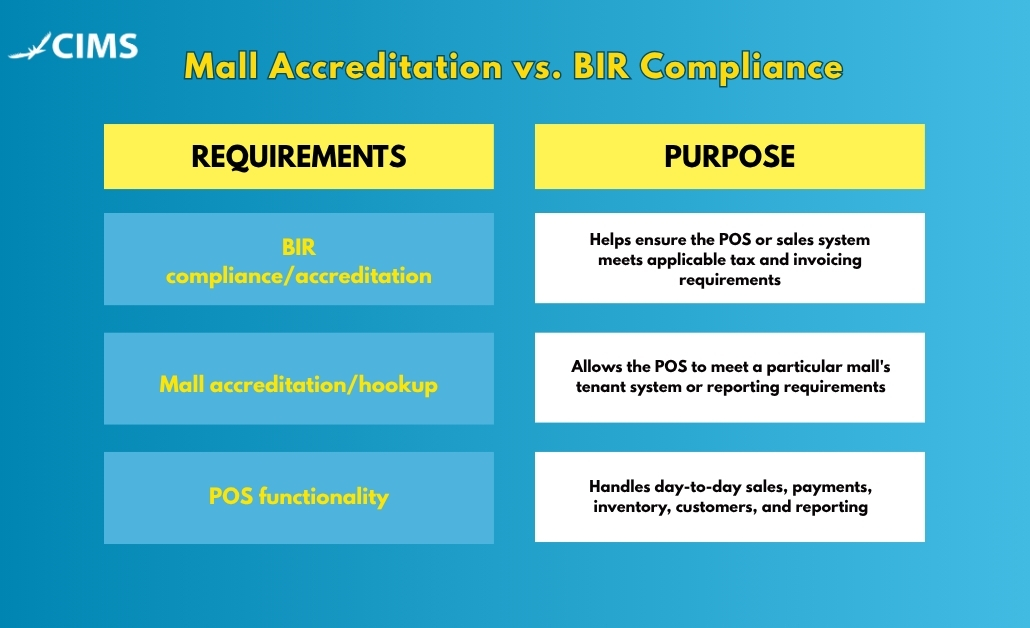
A mall-accredited POS may still need to meet applicable BIR requirements. Likewise, a BIR-compliant POS is not automatically accepted by every mall.
Mall Requirements: SM, Ayala, Robinsons, Megaworld, and More
There is no single universal mall POS requirement that applies to every shopping center in the Philippines.
Each mall operator may have its own tenant onboarding process, technical requirements, reporting specifications, and hookup procedures. Requirements can also change over time.
For this reason, businesses should treat a vendor’s accreditation list as a starting point and confirm their specific branch or mall before installation.
SM Supermalls
SM Supermalls operates a large network of shopping centers across the Philippines, and mall tenants may have specific requirements related to POS deployment and sales reporting.
POS providers that work with SM tenants may offer mall hookup assistance as part of their deployment service.
For example, Mosaic Solutions publicly announced a partnership with SM Supermalls and said it would deploy its business management systems across SM’s mall network.
KwikPOS also publicly lists SM among the major malls where it says its systems are accredited and can facilitate mall hookup.
Before opening, ask your POS provider and SM mall contact what current technical and reporting requirements apply to your store.
Ayala Malls
Ayala Malls is another major mall group where tenants should verify POS requirements before installation.
A vendor claiming Ayala accreditation should be able to explain what the accreditation covers and whether its team can assist with the required hookup.
For example, KwikPOS currently lists Ayala Malls among its mall accreditations.
The important point is that vendor accreditation does not replace tenant verification. Your store should confirm the current requirements with the specific Ayala property where you will operate.
Robinsons Malls
Robinsons Malls is another major mall operator with its own tenant processes.
If you are opening a retail store, restaurant, kiosk, or other business inside a Robinsons property, ask your POS provider whether it is currently accredited for that specific mall and whether the provider handles the hookup process.
KwikPOS publicly lists Robinsons among the major mall groups it supports.
Megaworld and Other Mall Operators
Mall POS requirements are not limited to the country’s largest mall groups.
Depending on your location, you may also encounter requirements from Megaworld Lifestyle Malls, Ortigas Malls, Vista Mall, WalterMart, Starmall, Evermall, and other shopping center operators.
KwikPOS, for example, publicly lists several of these mall groups in its accreditation information.
Mosaic Solutions also publicly identifies major mall accreditation as part of its POS offering. Its website currently displays SM Supermalls, Ayala Malls, and Megaworld Lifestyle Malls among its mall relationships.
Because accreditation lists and mall policies can change, use these public lists as references rather than assuming that every branch or tenant category has identical requirements.
How to Choose a Mall-Accredited POS: Checklist
Choosing a POS for a mall location requires more than comparing monthly subscription prices.
Use this checklist before signing a contract.
1. Confirm Accreditation for Your Specific Mall
Do not settle for:
“We’re accredited with major malls.”
Ask the provider:
- Is your POS accredited at my mall?
- Is the accreditation current?
- Does it cover my tenant category?
- Can you provide proof or documentation?
- Can your team handle the mall hookup?
A provider should be able to give you a clear answer.
2. Ask About BIR Processing
Your POS provider should explain what BIR-related assistance is included in the deployment.
BIR’s current eAccReg system provides processes for POS/CRM accreditation and registration.
Ask whether the provider assists with:
- POS registration
- Permit to Use requirements, where applicable
- Invoice or receipt configuration
- Required documentation
- BIR-related system setup
3. Check Hardware Compatibility
A mall POS installation may require more than software.
Consider:
- POS terminal
- Receipt printer
- Barcode scanner
- Cash drawer
- Customer display
- Network equipment
- Backup equipment
- Kitchen printers or KDS for restaurants
Make sure the hardware is compatible with the POS and suitable for your store’s daily transaction volume.
4. Understand Sales Data Transmission
Ask exactly what information needs to be transmitted or reported to the mall.
Depending on the mall’s system, this may include sales information or other tenant reporting data.
Your POS provider should explain:
- What data is transmitted
- How it is transmitted
- When it is transmitted
- What happens if the connection goes offline
- Who handles troubleshooting
5. Check Installation and Support
Opening a mall store involves strict deadlines.
Your POS provider should be able to give you a deployment timeline covering:
Installation → Configuration → Testing → Mall Hookup → Training → Go-Live
Ask who will be physically present during installation and who you should contact if there is a technical problem on opening day.
6. Calculate the Total Cost
Do not compare vendors based only on the advertised POS price.
Consider:
- Software fees
- Hardware
- Installation
- Mall hookup
- BIR assistance
- Training
- Support
- Maintenance
- Subscription fees
- Hardware warranty
- Additional terminals
- Additional branches
The cheapest initial quote may not always have the lowest total cost of ownership.
Comparison of Mall-Accredited POS Options in the Philippines
The following table provides a starting point for comparing providers. Accreditation claims should be verified directly with each vendor and with your mall before deployment.
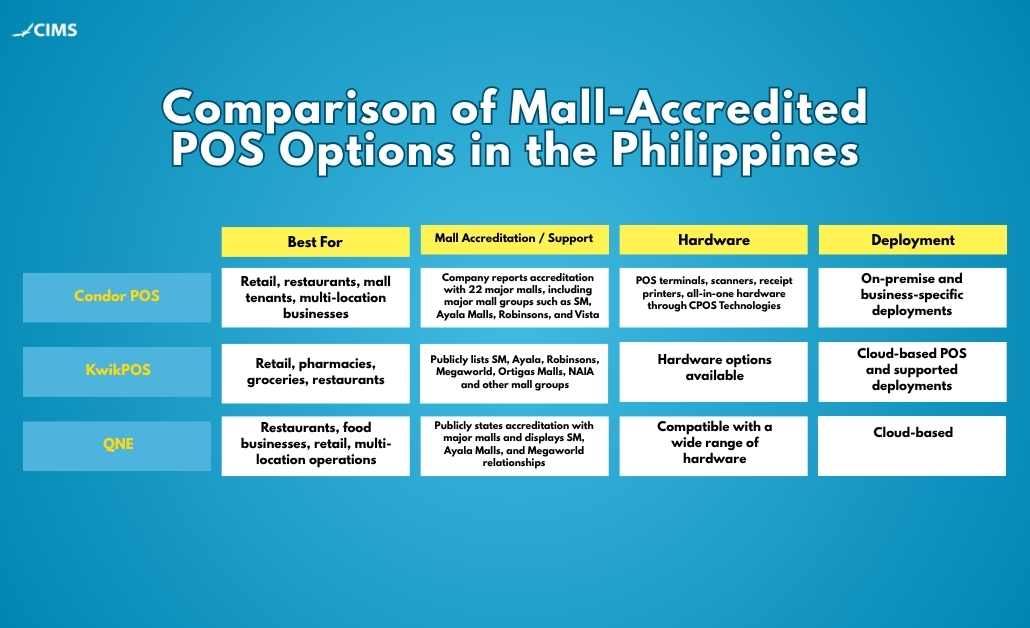
KwikPOS publicly describes mall hookup, BIR processing assistance, implementation, training, and opening-day monitoring as part of its services.
Mosaic Solutions states that its POS is BIR and mall accredited and offers restaurant and retail solutions, inventory, analytics, and multi-location capabilities.
Mosaic also describes its Tenant iQ platform as a system that can collect and consolidate tenant sales information for mall and food-court management.
Note: Pricing is intentionally not included because POS costs can vary significantly depending on hardware, number of terminals, business type, deployment requirements, mall hookup, and contract terms. Request a current quotation from each provider.
Mall POS Needs by Business Type
Not every mall tenant needs the same POS configuration.
Your business model should determine the features and hardware you need.
Restaurants and Cafés
Restaurants typically need more than basic checkout functionality.
Look for:
- Table management
- Dine-in and takeout orders
- Kitchen Display System or kitchen printing
- Multiple payment methods
- Discounts and promotions
- Inventory management
- Recipe or ingredient tracking
- Delivery integration
- Sales reporting
- Multi-branch management
A restaurant inside a busy mall may also need fast transaction processing and reliable offline capabilities.
Retail and Specialty Shops
Retail businesses often prioritize:
- Barcode scanning
- SKU management
- Product variants
- Stock tracking
- Discounts
- Customer management
- Returns and exchanges
- Multiple payment options
- Sales reporting
If you plan to operate several mall branches, look for centralized management and reporting.
Pharmacies and Groceries
Pharmacies and grocery stores may require more detailed product management.
Important features can include:
- Barcode scanning
- Product databases
- Inventory tracking
- Expiry-date monitoring
- Product variants
- Purchase management
- Sales reports
- Multiple payment methods
The POS should also be capable of handling high transaction volumes during peak mall hours.
Kiosks and Pop-Ups
Kiosks have different requirements.
A compact setup may need:
- Small POS terminal
- Receipt printer
- Cash drawer
- Barcode scanner, if applicable
- QR and card payment options
- Simple sales reporting
- Reliable connectivity
- Easy staff training
For temporary stores or pop-ups, portability and simple deployment can be more important than advanced enterprise features.
Why Condor POS for Mall Tenants
Condor POS Solutions has been serving Philippine businesses since 2009 and has experience supporting POS deployments for retail and food businesses.
According to Condor’s company information, its systems are accredited with 22 major malls in the Philippines, including major mall groups such as SM, Ayala Malls, Robinsons, and Vista. Accreditation should still be confirmed with the specific mall before deployment because mall requirements can change.
Condor also provides POS hardware through CPOS Technologies, including all-in-one POS terminals, receipt printers, scanners, and other retail hardware.
For mall tenants, the objective is not simply to install a POS. The deployment needs to account for the store’s operational requirements, hardware configuration, reporting, training, and mall hookup process.
Condor can assist businesses throughout the implementation process, from POS setup and hardware deployment to user training and technical support.
For businesses planning a new mall location, the best time to discuss POS requirements is before the store opens. This gives the POS provider time to review the mall’s requirements, prepare the hardware, configure the system, and coordinate the necessary hookup.
Frequently Asked Questions About Mall-Accredited POS Systems
Do all mall tenants need an accredited POS?
Not necessarily in exactly the same way. Requirements depend on the mall operator, property, tenant category, and lease or technical requirements.
Before purchasing a POS, ask your mall’s leasing or tenant relations team whether a specific POS accreditation or hookup is required.
How long does mall POS hookup take?
The timeline varies depending on the mall, POS provider, technical requirements, availability of hardware, and tenant’s opening schedule.
Ask your provider for a complete timeline covering installation, testing, mall coordination, hookup, and go-live.
Do not wait until the day before opening to arrange the process.
Can I switch POS providers after opening?
In many cases, businesses can change POS providers, but the process may involve data migration, hardware replacement, staff retraining, BIR requirements, and mall coordination.
Before switching, ask both the existing and new provider about the transition process.
Is mall accreditation the same as BIR accreditation?
No.
BIR requirements are government tax and invoicing requirements. Mall accreditation or hookup relates to the mall’s own tenant systems and requirements.
A POS provider may need to satisfy both.
The BIR maintains an official system for POS/CRM accreditation and registration through eAccReg.
What if my mall isn’t on the vendor’s accredited list?
Ask the POS provider whether they can coordinate with the mall and complete the required technical process.
Do not assume that a provider can complete the hookup simply because it works with other malls.
Get confirmation from both the POS provider and the mall before purchasing.
What Should You Ask Your POS Provider Before Signing?
Before making a decision, ask these questions:
- Are you currently accredited with my specific mall?
- Can you provide proof of accreditation or previous mall deployments?
- Do you handle mall hookup?
- Do you provide BIR processing assistance?
- What hardware is included?
- What is the complete installation timeline?
- Who will assist us during opening day?
- What happens if the internet connection goes down?
- What support is included after installation?
- What are the recurring and one-time costs?
- Can the system support additional branches?
- Can you migrate our data if we switch systems later?
These questions can help you compare vendors based on the complete deployment rather than the POS price alone.
Conclusion: Choose Your POS Before Your Mall Opening
Choosing a POS system with mall accreditation in the Philippines should be part of your store-opening plan.
Before signing with a provider, confirm three things:
First, verify mall accreditation. Make sure the provider can support your specific mall and tenant requirements.
Second, check BIR requirements. Mall accreditation and BIR compliance are separate considerations.
Third, evaluate the complete deployment. Consider hardware, installation, mall hookup, training, support, reporting, and total cost.
A POS system is not just a cash register. For a mall tenant, it can become an important part of your daily operations and reporting workflow.
If you’re planning to open a store in a Philippine mall, start the POS discussion early.
Check if Condor POS is accredited in your mall.
Contact Condor POS Solutions to discuss your mall location, business type, number of POS terminals, hardware requirements, and deployment timeline.
