

Sporting goods stores carry a wide range of products, from athletic apparel and footwear to sports equipment and accessories. Managing such diverse inventory requires a reliable retail management system capable of tracking multiple product types, sizes, brands, and seasonal demand patterns.
Unlike many other retail businesses, sporting goods retailers often handle complex product variants, specialty orders, equipment services, and occasional rental items. These operational challenges make choosing the best POS system for sporting goods stores an essential decision for business owners.
A modern POS hardware and software system does more than process transactions. It helps retailers manage inventory accuracy, track product performance, streamline checkout operations, and improve the overall customer experience.
In this guide, we explore the unique operational needs of sporting goods retailers, the most important POS features to consider, and how to select the right system for your store.
 Unique Needs and Challenges of Sporting Goods Retail
Sporting goods retailers face several operational challenges that differ from traditional retail stores.
One major challenge is variant management. Products such as shoes, uniforms, and sports apparel often come in multiple sizes, colors, and styles. A POS system must handle these variations efficiently to avoid inventory errors.
Many stores also offer equipment services or repairs, such as restringing tennis rackets, adjusting bicycles, or customizing team uniforms. The POS system must support service orders alongside retail transactions.
Some sporting goods stores provide equipment rentals or product demos, especially for high-value gear. Tracking these items requires careful inventory monitoring.
Retailers may also receive special orders or backorders for rare equipment or customized products. Managing these orders efficiently improves customer satisfaction.
Another challenge is handling deposit payments or layaway plans for expensive items such as bicycles or gym equipment.
Finally, many sporting goods retailers operate across multiple locations, including retail storefronts, warehouses, and storage facilities. A POS system must support inventory tracking and stock transfers.
Key Features to Look for in a POS System
Choosing the best POS system for sporting goods stores requires evaluating several important features.
Multi-Variant Inventory Tracking
This makes inventory tracking more complex than traditional retail. A modern POS system with matrix inventory management helps retailers accurately track product variations, reduce stock errors, and maintain better control over inventory levels.
Retailers looking to improve their inventory processes can explore the articles for guides and best practices on retail inventory management.
Product Images and Detailed Attributes
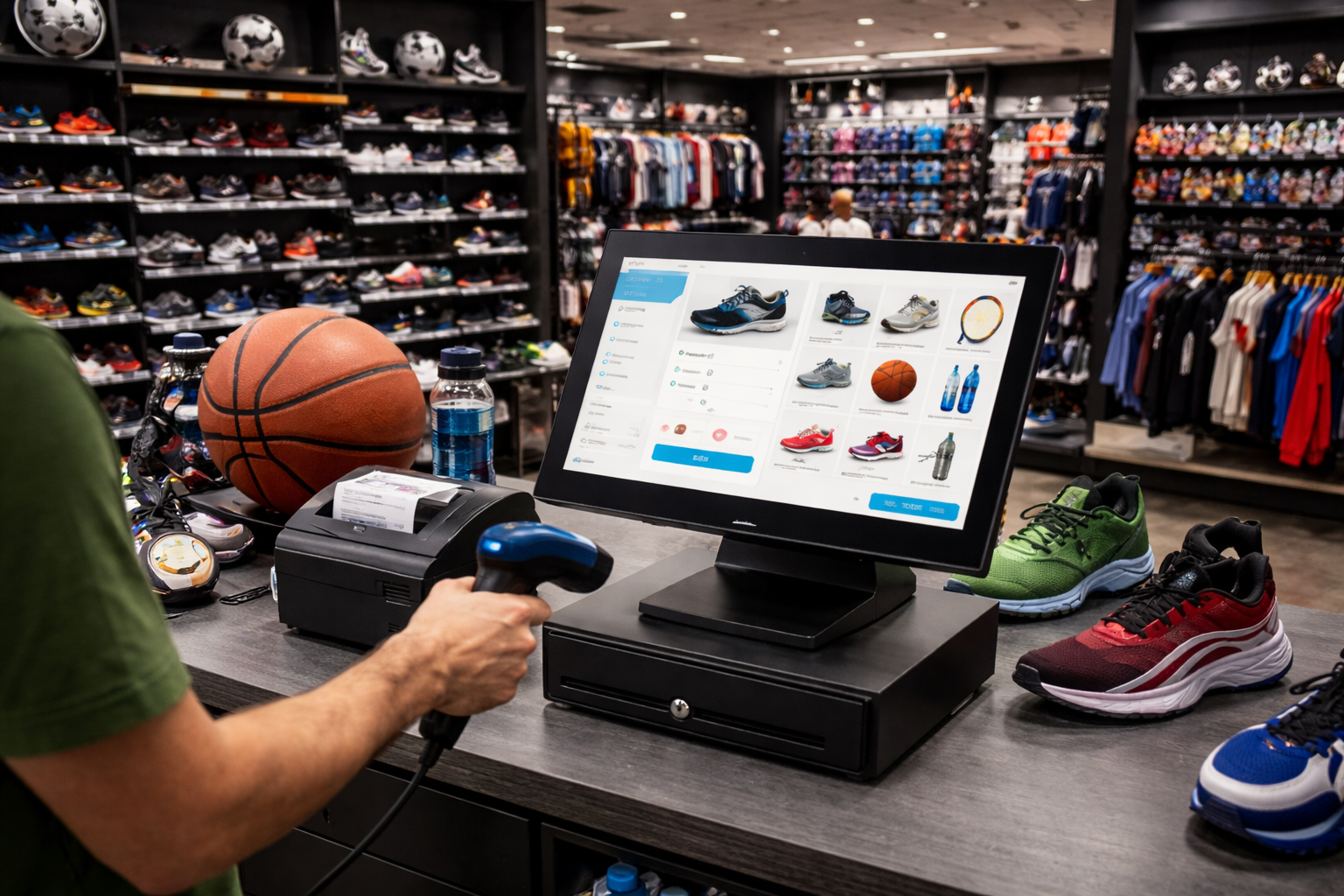
Displaying product images and specifications at the POS helps staff quickly identify items and avoid checkout errors.
Special Orders and Service Workflows
A good POS system should support special orders, backorders, and service requests such as equipment adjustments or repairs.
Businesses can review step-by-step tutorials and training materials to understand how these workflows operate in modern POS systems.
Quotations and Estimates
Many sporting goods stores sell equipment in bulk for schools, teams, or organizations. POS systems that support quotation features allow staff to generate price estimates quickly.
Layaway and Deposit Payments
High-ticket items such as fitness machines or bicycles often require deposit payments. The POS system should support flexible payment options including partial payments or layaway plans.
Promotions and Discounts
Retailers frequently offer promotional discounts during sports seasons or clearance periods. The POS system should allow flexible pricing rules and group discounts.
Multi-Location Inventory Visibility
If the business operates multiple stores or warehouses, the POS system should provide real-time inventory visibility across all locations.
Customer Profiles and Loyalty Programs
Customer relationship management tools allow retailers to store purchase history, track product preferences, and reward repeat customers.
Employee Roles and Commission Tracking
Sporting goods sales staff often provide expert advice to customers. POS systems that track employee performance or commissions can help motivate staff and improve productivity.
Reporting and Sales Analytics
Advanced reporting tools allow retailers to analyze sales trends, identify best-selling products, and track profit margins.
Operational and Workflow Considerations
Implementing a POS system requires evaluating how it fits into daily store operations.
Store layout plays an important role. Some retailers place POS terminals at the checkout counter, while others use mobile devices to assist customers on the sales floor.
Handling large or bulky items such as exercise equipment may require shipping coordination, delivery scheduling, or handling fees.
Employee training is also essential. Staff should understand how to manage product variants, process special orders, and assist customers during checkout. Businesses can explore additional training materials and tutorials available in the learning hub to improve staff onboarding.
Inventory replenishment cycles should also be considered. Sporting goods demand often fluctuates based on sports seasons, holidays, and promotional campaigns.
Finally, retailers should ensure that the POS system supports efficient warehouse logistics including product receiving, staging, and inventory transfers.
Cost vs Value Trade-Offs
When evaluating the best POS system for sporting goods stores, businesses must consider both upfront and ongoing costs.
Initial expenses may include POS hardware such as registers, barcode scanners, receipt printers, and setup services.
Recurring costs may include software subscriptions, maintenance services, and system updates.
Additional costs may come from payment processing fees or third-party integrations.
Despite these costs, the right POS system delivers long-term value through improved inventory accuracy, better customer service, and increased operational efficiency.
Retailers who want to see how modern POS systems support these operations can schedule a demo to explore system features and workflow automation.
How to Choose the Right POS System for Your Sporting Goods Store
Selecting the right POS system starts with understanding your store’s specific needs.
First, evaluate your product mix. Some stores focus mainly on apparel and footwear, while others specialize in equipment, accessories, or team gear.
Next, create a list of must-have features such as variant inventory tracking, service orders, or multi-location inventory.
Testing real workflows is also important. Staff should simulate product lookups, special orders, inventory transfers, and returns to evaluate the system’s usability.
Payment compatibility is another factor. The POS system should support popular payment methods used by customers.
Retailers should also evaluate vendor support, training resources, and system reliability.
Finally, consider long-term growth. The POS system should scale easily if the business expands into additional locations or introduces new product lines.
Conclusion
Choosing the best POS system for sporting goods stores is critical for managing complex inventory, improving operational efficiency, and delivering a better shopping experience.
A well-designed POS system allows retailers to track product variants, manage special orders, monitor inventory across locations, and generate detailed sales reports.
Ultimately, the right POS solution should match the store’s size, product mix, and customer expectations.
Before implementing a new system, business owners should conduct trials, test workflows, and ensure the POS platform supports both current operations and future growth.
