
Online food delivery has become a major driver of growth in the restaurant industry. As customer demand for convenience continues to rise, restaurants are expected to manage online orders quickly, accurately, and efficiently across multiple platforms. With multiple delivery apps in use, handling orders manually can slow down operations and increase the risk of errors.
Food delivery integration allows restaurants to connect their POS systems directly with food delivery platforms. Instead of managing separate tablets and manually re entering orders, restaurants can streamline operations through a centralized system. This improves order accuracy, speeds up preparation, and enhances the overall customer experience.
This article explains what food delivery integration is, why it matters for modern restaurants, its key features, benefits, challenges, and how businesses can choose the right solution. It also highlights current providers and future trends shaping the food delivery landscape, with Condor POS Solutions supporting restaurants in managing delivery operations more efficiently.
What is Food Delivery Integration?
Food delivery integration is the seamless connection between a restaurant’s POS system, website, or ordering platform and third party food delivery services such as GrabFood, Foodpanda, Uber Eats, and DoorDash. Through integration, online orders are automatically transmitted to the restaurant’s POS or kitchen display system.
When a customer places an order on a delivery app, the order flows directly into the restaurant’s system without manual input. Kitchen staff can begin preparation immediately, while the delivery rider collects and delivers the order to the customer. This process reduces delays and minimizes human error.
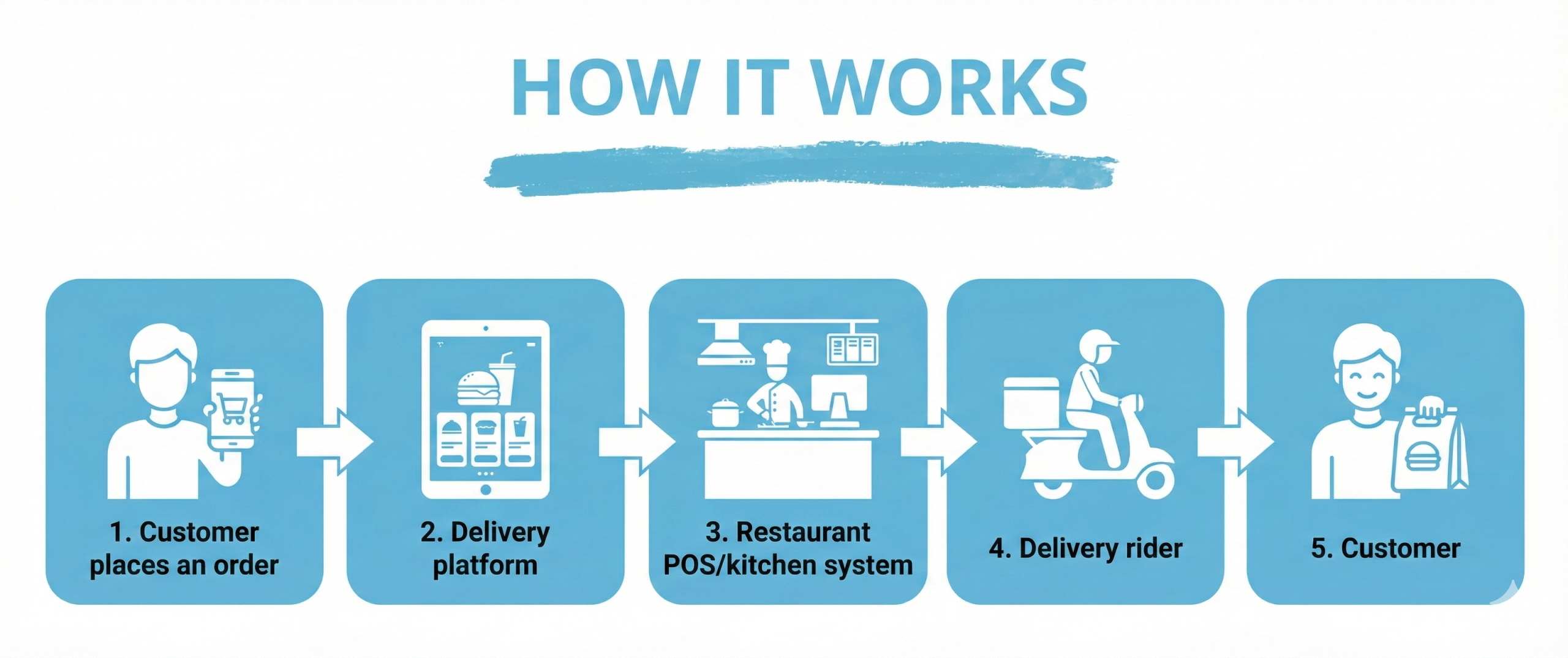
Food delivery integration acts as a digital bridge between customer demand and restaurant operations. By automating order flow, restaurants can manage multiple delivery channels more efficiently while maintaining accuracy and consistency.
Why Food Delivery Integration Matters
Food delivery has evolved into a critical revenue stream for restaurants of all sizes. Customers expect fast service, accurate orders, and real-time updates, making efficient order management essential. Restaurants that rely on manual processes often struggle during peak hours.
Without integration, staff must re-enter orders from delivery apps into the POS system, increasing the risk of mistakes and slowing down service. Food delivery integration eliminates these inefficiencies by automating the entire order process.
In a competitive market, restaurants that adopt integration gain an advantage through faster order processing, better customer experience, and improved operational control. Integration also helps reduce order backlogs and improves kitchen workflow during busy periods.
Key Features of Food Delivery Integration
Food delivery integration offers real time order syncing, ensuring that delivery orders automatically appear in the POS or kitchen system as soon as they are placed. This allows staff to respond immediately without switching between devices.
Menu management enables restaurants to update items, pricing, and availability across multiple platforms from a single dashboard. Inventory tracking helps prevent stock shortages by automatically adjusting item availability in real time.
Delivery tracking improves transparency by allowing customers to monitor order progress. Payment integration supports digital wallets, card payments, and cash on delivery reconciliation, making financial reporting more accurate. Analytics and reporting tools provide insights into sales performance, customer preferences, and delivery trends.
Condor POS Hardware Solutions supports these features to help restaurants manage delivery operations efficiently.
Benefits of Food Delivery Integration
One of the main benefits of food delivery integration is improved operational efficiency. Automated order entry reduces errors, saves staff time, and allows teams to focus on food preparation and customer service.
Orders reach the kitchen faster, resulting in quicker preparation and delivery. Customers receive accurate orders with fewer delays, leading to higher satisfaction and repeat business.
Restaurants can manage multiple delivery platforms without additional administrative work. Centralized data also enables business owners to analyze demand patterns, optimize menus, and identify new revenue opportunities.
Challenges in Food Delivery Integration
Despite its advantages, food delivery integration comes with challenges. Integrating multiple platforms can be technically complex, especially for restaurants using older or legacy POS systems.
Costs may include setup fees, subscription charges, and commissions from delivery platforms. Restaurants may also have limited access to customer data due to reliance on third-party apps.
Connectivity issues can disrupt operations, and maintaining consistent menus and pricing across platforms requires careful monitoring and management.
How to Choose the Right Food Delivery Integration for Your Business
Restaurants should start by assessing their size, volume, and operational needs. Small cafés may only require basic integration, while larger chains often need advanced features and scalability.
Compatibility with existing POS systems and popular delivery platforms in the region is essential. A user friendly interface helps staff adapt quickly and reduces training time.
Cost transparency is important to avoid hidden fees, while scalability ensures the system can grow with the business. Security and data protection should also be considered when selecting a provider. Condor POS Solutions offers flexible options designed to support restaurants of different sizes and operational requirements.
Popular Food Delivery Integration Providers
Several providers offer food delivery integration solutions worldwide. Deliverect is widely used by multi location restaurants to connect POS systems with major delivery platforms. Otter focuses on centralized order management and analytics.
Square for Restaurants combines POS functionality with delivery integration, making it suitable for small businesses. GloriaFood provides an affordable option for smaller restaurants, while Chowly specializes in syncing delivery orders directly into POS systems.
In Southeast Asia, GrabFood and Foodpanda dominate the delivery market. In the United States, Uber Eats and DoorDash are widely used, while Deliveroo is popular in the United Kingdom. The right provider depends on location, restaurant size, and operational needs.
The Future of Food Delivery Integration
The future of food delivery integration is shaped by automation and innovation. AI-powered tools are enabling predictive ordering and smarter menu recommendations based on customer behavior.
Drone and robotic deliveries are being tested in select markets, while personalization through data analytics continues to improve customer engagement. Contactless and cashless payments are becoming standard, and many restaurants are investing in first party delivery solutions to reduce reliance on third-party platforms.
Conclusion
Food delivery integration plays a vital role in improving restaurant efficiency, customer satisfaction, and long-term growth. By connecting delivery platforms directly to POS systems, restaurants can reduce errors, streamline operations, and gain valuable insights.
The best integration solution depends on business size, budget, and customer base. Restaurants that adopt food delivery integration early are better positioned to stay competitive in an increasingly digital industry. Condor POS Solutions provides tools designed to support this transition effectively.
Discover how Condor POS Solutions can simplify food delivery integration for your restaurant. Book a free demo today!